Review: "Why There Is No God" by Armin Navabi
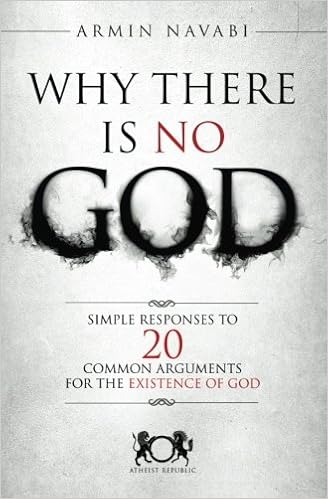
I decided to read Why There Is No God by Armin Navabi because it claimed to have answers from an atheist's viewpoint to counter "questions" posed by theists about the existence of God.
In the introduction, I was pleased to read that, while written from an atheist's point of view, the book was there to provide these answers not only for the atheist, but also for the believing Christian—to provide them with an understanding of how those who oppose their view think and allow them to adjust their arguments accordingly.
It also addressed those who are agnostic—riding the fence between belief and disbelief—in order for them to challenge the outcome from both perspectives and come to a conclusion of their own.
A very noble statement and, honestly, one that kept me reading. But then we get into the actual book.
First off, most of the questions asked are pretty simplistic. Sure, I can see these debates coming up between believers and non-believers, but these questions are more rebuttal responses than questions. Quite frankly, the responses the author gives are weak and, in my opinion, not very well thought out. It would be quite easy for a learned theologian to counter these answers with something much more intellectual. This is the theme throughout the entire book.
Next, the author does pose some very good considerations for people who are truly seeking truth and understanding about the existence of a deity. One that I struggle with is the idea of God or the deity's character. The author states:
“Terrible things happen to people every day. Children die tragically young, natural disasters wipe out whole communities and people die from accidents and disease. These do not suggest a righteous and compassionate god. These suggest that God is either powerless, cruel or non-existent.”
I would even add a fourth characteristic: existing but oblivious. This characteristic supports the whole "watchmaker" vision of God. If you have never heard that analogy, it goes like this: God—the watchmaker—creates, in this case the universe and everything in it, and then pays no more attention to his creation than a watchmaker would to all the watches he makes.
But back to the book. I think the author is correct in the fact that events in time, if God exists, define one or more of these characteristics.
Finally, the author makes some comments that can be seen right through as simple atheist regurgitations, and some that are flat-out not true. He makes a very bold claim about citing things in context, to the extent that his position is that context is not that important. That is a big mistake. He also cites some scientists and thinkers who have been raked over the coals by others, proving that much of their theories are skeptical at best. He probably should have done a little more research there, I think.
All in all, there are some basic questions and responses here for which anyone with some intelligence would be able to ascertain the outcome or response. None of what the author wrote, in my opinion, would change anyone's belief. Nothing he presented makes me think that atheism is the logical answer or that theism is the truthful answer. I leave with just as many questions and misgivings as I had before I started reading.